
Drone Bathymetry
Drone Bathymetry is the act of using a drone and a sonar to measure (map) the depth of water in oceans, rivers, or lakes. Bathymetric maps look a lot like topographic maps, which use lines to show the shape and elevation of land features. On topographic maps, the lines connect points of equal elevation. On bathymetric maps, they connect points of equal depth.
Drone Echosounders are used to make bathymetric maps. An echo sounder sends out a sound pulse from just below the water surface, to the ocean floor. The sound wave bounces back to the echo sounder. The time it takes for the pulse to leave and return to the echosounder determines the bathymetry of the seafloor. The longer it takes, the deeper the water.
Drone Echosounder (Sonar) Systems
An echosounder is a type of sonar. Most people have heard that ships have sonar to make sure they don’t hit the bottom and run aground. Echosounders measure a small area of the fresh waterbed or seabed to provide the user with a clear understanding of where the bottom lies (usually in metres). Although echosounders have improved in performance over recent years, the best results come from knowing the velocity of sound in the water body being surveyed.
The speed of sound in water varies, depending on the temperature, salinity (saltiness), and pressure of the water. In general, sound travels faster as temperature, salinity, and pressure increase. For multi-beam systems, the velocity of sound in the water must be known for accurate results. For further information on echo sounders and their uses, please see here.
Drone Multi-Beam (MBES) v Single Beam (SBES) Systems
Whereas single-beam systems (SBES) measure depth using a single ‘shot’, multibeam systems shoot out multiple shots within a given swath. This means that for every given length, the multi-beam system can obtain significantly better data density over SBES systems. Furthermore, this density is achieved with fewer survey lines, meaning less cost and better survey efficiency.
Like SBES systems, there are options for both single frequency and dual frequency. As of the 2025 summer launch date, only a single frequency system is available at 240 kHz, and the processing is performed in BeamworX using both AutoPatch and AutoClean. By 2026, it is hoped that like the SBES systems, the processing can be performed in Hydromagic.
IMPORTANT: Speed of Sound in Water
Due to the nature of the data obtained via the MBES, the velocity of sound in the water body being surveyed must be known accurately. Therefore, we highly recommend users measure the speed of sound using a velocity profiler like the Teledyne Valport SWiFT SVP. This system is also flown using the SkyHub TTF system.

UgCS Drone Bathymetry
Luckily, UgCS provides a comprehensive range of hydrography options that can support effective bathymetric mapping surveys using echosounders. As well as a range of echosounders (SBES single or double frequency and MBES multibeam), we can also supply salinity, turbidity, flow speed, and sound velocity sensors.
Benefits of Drone Bathymetry
There are several good reasons why airborne deployment of hydrography sensors is a good idea:
- Small and/or shallow
- Hard to reach locations/no points of entry
- Seaweed, debris, mechanical pollution (Grasshop)
- Drinking water reservoirs (no boats)
- Fast set-up, easy deployment
- Good repeatability
- Excellent manoeuvrability
Drone Echo Sounder Applications
- River Channel Depth Mapping (Single/Dual/MBES)
- Waterway Scour Identification (Single/Dual/MBES)
- Submerged Debris location (Single/Dual/MBES)
- Soft Sediment Depth Indications (Dual)
- Fresh water reservoir surveys (Single/Dual/MBES)
- Support primary sensor surveys (Single/Dual/MBES)
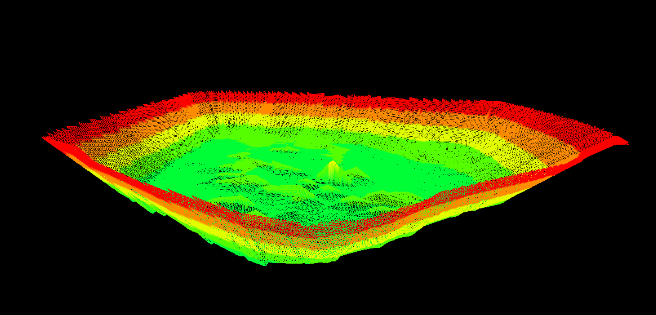
UgCS Echosounder Options
- Single Frequency (450 kHz) & Temperature
- 0.3 m to 100 m depth (practical use >30 cm)
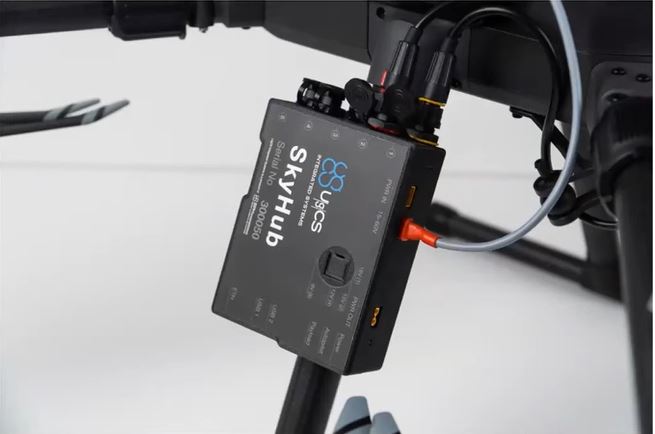
- Connects directly to SkyHub
- Tilt sensor provides SkyHub with quality control
- Kit weight ~1.3 kg
- Two modes: standard NMEA (O803) and full echo data
- CSV for X, Y, and Z • SEG-Y for HydroMagic software
- Dual frequency (50 kHz and 200 kHz) & temperature
- 1.3 m to 200 m depth. Soft sediment layer thickness/penetrates submerged vegetation
- Connects directly to SkyHub
- Tilt sensor provides SkyHub with quality control
- Kit weight ~2.3 kg
- Two modes: standard NMEA (O803) and full echo data
- CSV for X, Y, and Z • SEG-Y for HydroMagic software
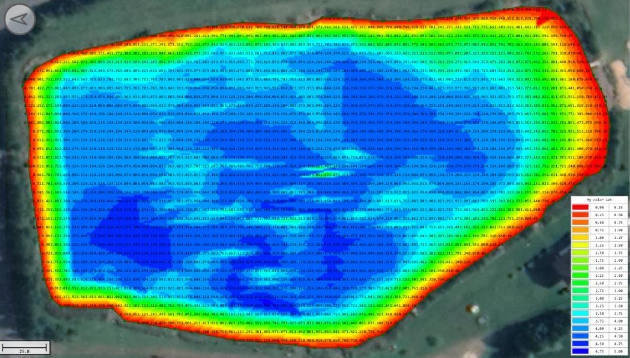
Drone Multi-beam Cerulean Echo Sounder System
- Frequency 240 kHz
- 0.5 m to 50 m depth.
- Connects directly to SkyHub
- Onboard IMU for tilt and roll compensation
- Effective kit weight ~2.4 kg
- Processed Data in BeamworX

Available Case Studies
To get access to any of these UAV Echosounder System case studies, please get in touch:
- Coal Mine Reclamation Surveys with a UAV-Based Echo Sounder
- Bathymetric Survey Time reduced by 75% with Drone-based Echo Sounder Technology
- UAV-Based Echo Sounder System Optimised Water Resource Management in Chile
- Drone-based Echo Sounder Detects Sunken Boat in Ecuador
- Drone-based GPR and Echo Sounder for Mining Operations Enhancement
- Enhancing Stormwater Management through Drone-Mounted Echo Sounder Technology
- A one-day drone survey along the 10 km corridor, utilising multi-sensor technology
- UAV Echo Sounder overcomes the obstacles to surveying physically inaccessible areas
- Bathymetric surveys with a UAV and an echo sounder successfully conducted in Israel
- EAGE UAV Community members demonstrated LiDAR and bathymetric systems in Tartu, Estonia.
- UAV-Based Echo Sounder Mapping Shows 87% Correlation with Verified Depth Measurements
- Multi-Sensor UAS Hydrometry Validated at Centimetre-Level Precision in Shallow, Vegetated, and Flood-Affected River Zones
For further information on anything on this page including access to case studies, contact us at: info@jbuas.co.uk. Or, simply follow this link: Get in touch.