


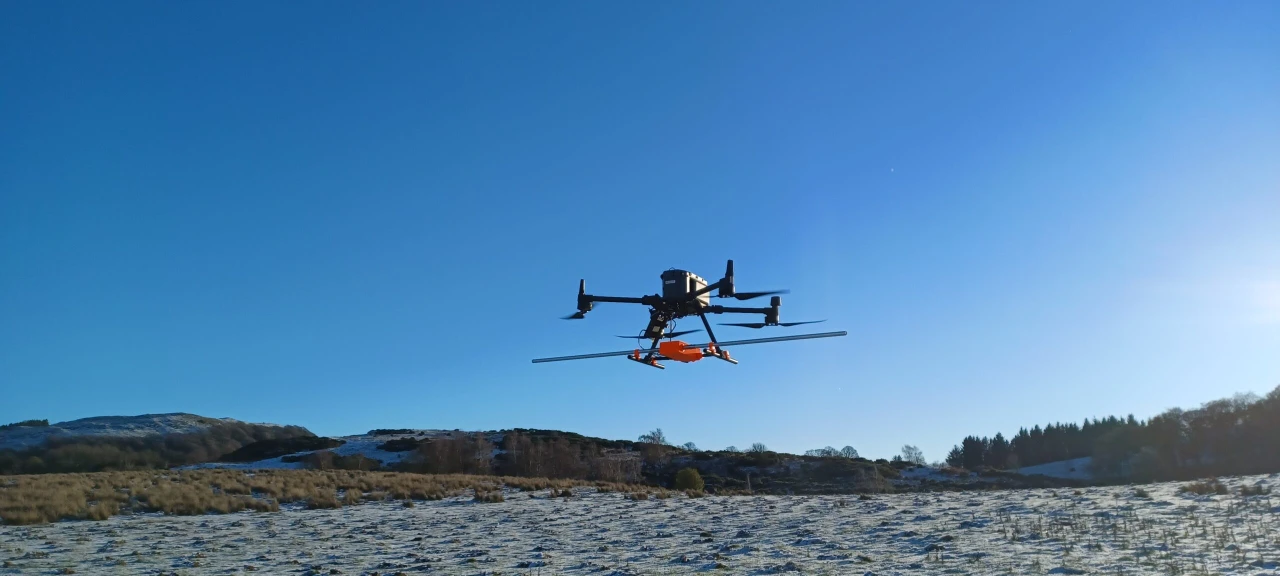
In January 2023, JBUAS supported testing in Scotland of a new Low Frequency (LF) Ground Penetrating Radar (GPR) that SPH Engineering designed for integration with the DJI M300 RTK. Our customer invested in the LF GPR system and requested help with initial configuration and testing. After a full day of flying different configurations, the team gained a clear understanding of the technology.
The GPR Technology
The LF Drone GPR is a single-channel ground-penetrating radar system with an unshielded dipole antenna. The system utilises several frequencies depending on the length of poles used for the application. The system also utilises a newly developed approach based on real-time sampling (RTS), with hardware stacking. This enables the system to provide clean profiles for evaluation and interpretation. The GPR comes with three different centre frequency options, including 100 MHz, 150 MHz, and 300 MHz.
SkyHub & TTF Feature
As part of this GPR system, all the data is recorded within the UgCS SkyHub for effortless download of SEG-Y files into Prism 2 via WIFI or Ethernet cable. Furthermore, the UgCS True Terrain Following Feature (TTF) enables the drone to fly safely at the low levels required for good data capture.
Soil Conditions
The trial was conducted on an active project site where the developers required an understanding of the soil depth to rock. On the day of the trial, the air temperature was zero degrees centigrade, resulting in the ground being frozen. There was some light vegetation, and the soil type was loam.
Results
As can be seen from the 150 MHz profile, we were able to identify the different layers quite well and certainly enough for direct export to a GIS for planning requirements. Overall, the drone LF GPR demonstrated that for defining sediment layers, it was more than up to the task.
Further Trials
There will be further trials of this system in the coming weeks, including UXO, peat depth measurements, and further sediment work. If you would like to learn more about the system or indeed would like to trial the system, please get in touch.